
Writing a memoir can take months (if not years) of your life. To cut down on your chances of disappointment down the road, you need to know what you’re writing, and for whom. First, make sure you’re completely clear about what a memoir is, and how it differs from an autobiography. Writing a memoir is about more than describing events that have happened in your life; it's also an exercise in writing on a theme. These three powerful memoir examples will demonstrate how to draw people into a stranger's life story. Along with our sample, they will help you craft your own memoir to engage readers and share insights from your. Writing a memoir, my story, has released me from the prison. I feel like I have landed on the shores of the promised land; I have survived. The writing itself offered me clarity. And seeing as memoir writing requires you to write about your experiences as honestly as possible, you will need a set plan on how to write properly. Here are 5 highly effective memoir writing tips for beginner writers. Be as honest as possible. If there is one thing you should remember when writing your memoir, it is to be as honest as.
If you are thinking of writing a memoir of your very own, you should know that there are a myriad of things you should take account of. This is especially true if you are just starting out as a writer. Being a beginner you would understandably not know where to begin and the process could get confusing fairly quickly. And seeing as memoir writing requires you to write about your experiences as honestly as possible, you will need a set plan on how to write properly.
Here are 5 highly effective memoir writing tips for
beginner writers.
1. Be as honest as possible
If there is one thing you should remember when writing your memoir, it is to be as honest as possible. This is because your readers are giving you the benefit of the doubt. They believe that what you tell them is the truth. They believe that the events that state in your memoir really happened. You can use monikers or change some of the character’s names if you want to preserve their identities. But as for the events and the effect that they have on your life, you should be as truthful as possible.
2. Have a set theme
Aside from being as honest as possible, it is important that your memoir follows a set overall theme. It could be progress, redemption, regret or forgiveness. It can technically be anything you can think of. For example, you are writing a memoir on your childhood. And because you are looking back on your past, the theme of your memoir could be about nostalgia. All in all, it always helps to have a set theme, because it brings all of the memories and recollections together.
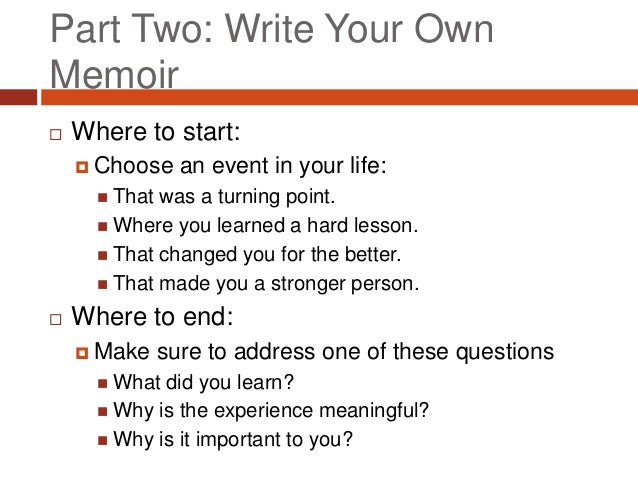
3. Choose a specific memory to write about
When you write your memoir, it always helps that you choose a specific set of memories to write about. For example, you are writing about your early teenage years. So the specific memory should encapsulate the entirety of your early years as a teenager. This memory could be the first time you fell in love, first instances of your puberty or the first time you kissed someone.
4. Infuse emotion into your writing
Seeing as memoires take a great deal of introspection to write, it always pays to infuse emotion into your writing. This is because the more emotion you put into your writing, the more likely it will capture your reader’s attentions. It will also make your writing a lot more relatable and can even earn the empathy of your readers. Just make sure that you don’t make your writing too emotional. Because it might come out as cloying or oversentimental.
5. Show your growth as person
It is very important that you show your growth as a person, throughout the entire memoir. Remember that the main reason why your readers even read your memoir, is that they want to know how you evolved as a person. They want to see how the trials and tribulations shaped your perceptions on life. And if you fail to do this, it might annoy your readers, and they will deem your work as irrelevant or pointless. Overall, it always pays to show your growth as a person.
Before you go, check out these related resources that you might also like:
 Read more.
Writing a memoir is about more than describing events that have happened in your life; it's also an exercise in writing on a theme. These three powerful memoir examples will demonstrate how to draw people into a stranger's life story. Along with our sample, they will help you craft your own memoir to engage readers and share insights from your life.
Three Memoir Examples to Inspire
A good memoir relays real-life events in an engaging way. Studying memoirs can help you write a personal essay for a college application or an assignment, and it can improve your own storytelling abilities.
I Know Why the Caged Bird Sings
I Know Why the Caged Bird Sings is a famous memoir by poet Maya Angelou, available from Penguin Classics. It chronicles her experience of growing up amid racial bigotry and personal challenge. It's not just her heartwrenching tale but also the vivid imagery that makes it a page-turner.
The dress I wore was lavender taffeta, and each time I breathed it rustled, and now that I was sucking in air to breathe out shame it sounded like crepe paper on the back of hearses.
Angela's Ashes
Frank McCourt's Pulitzer Prize-winning memoir, Angela's Ashes, tells the story of his upbringing in the Irish slums during the era of the Great Depression. Published by Simon and Schuster, this memoir reads like a novel as Frank somehow manages to withstand an unspeakably difficult childhood.
When I look back on my childhood I wonder how I managed to survive at all. It was, of course, a miserable childhood: the happy childhood is hardly worth your while.
All Creatures Great and Small
James Herriot's All Creatures Great and Small proves that a memoir doesn't have to deal with triumph over adversity; it can also be about finding wisdom and joy in the everyday. This beloved classic, published by MacMillan, tells the tale of Herriot's life as a country veterinarian in the Yorkshire Dales.
I lay face down on the cobbled floor in a pool of nameless muck, my arm deep inside the straining cow, my feet scrabbling for a toe hold between the stones.
Writing a Memoir: An Example
Imagine you want to write a memoir about your experience as a shy child who had just moved to a rural community. This process can help.
List Real Life Facts
Start with a list of facts and experiences that you may want to include:
- You had no friends except your dog.
- Your dad left your family the previous year.
- Your mom made you join Girl Scouts, and you needed to sell cookies door-to-door.
- People in this town were suspicious of outsiders.
- Because you had just joined the Girl Scouts, you didn't have very many badges yet.
Identify a Theme and Conflict
Writing A Memoir Video
Before you begin writing, you need to know your theme. What do you want readers to learn from your memoir? You also need a central conflict. Study the types of conflicts in stories and decide which one you want to use.
- Theme - People aren't always what they seem.
- Conflict - You must face your fears in order to grow stronger.
Organize the Story to Build Tension
Now that you know the conflict and the theme you want the reader to understand, you need to organize the story so the tension builds toward the conflict. This is something you can do in a memoir that does not ordinarily happen in an autobiography.
In this example, you could arrange the events as follows:
- The Girl Scout troop leader hands out the cookies and says that if you sell 24 boxes, you will earn a badge for your uniform. You really want the badge.
- You load the cookies in your wagon and set off to make some sales. As you stand in front of the first house, you are afraid to knock.
- You remember a previous experience knocking on the door of a house and having it slammed in your face.
- You walk up to the house and are greeted by a grumpy old woman.
- You make the sale.
- Eventually, you receive your badge for selling 24 boxes.
Sample Memoir Excerpt
Putting all these pieces together, here is an example of how the narrative outlined above might play out in the actual text of the memoir:
The gravel crunched under the wheels of my red wagon. My father had bought it for me the week before he left us, and I'd never used it before. I hadn't wanted to use it, not even today, but I needed something to haul the cookies.
I stopped in front of Mrs. Nelson's house. I could feel her looking at me through the lace curtains, even though I couldn't see her. Now that I wasn't pulling the wagon, everything was silent. There was no wind. Even the birds had stopped their chirping. The curtain in Mrs. Nelson's front window moved a little bit.
Last year, the same month my dad had driven away, I'd had to sell chocolate bars for my old school. Dad had promised to take me, but he didn't. So while Mom was at work, I'd packed up the chocolate bars and knocked on the door across the street. When the door opened, I began to talk about my school. Before I'd even explained why I was there, the lady had slammed the door in my face. I was the only kid who didn't sell any chocolate bars that year.
Now, I took a deep breath and pulled the wagon up Mrs. Nelson's front walk. The paint was peeling on her railing, and her front door was a dirty white. I knocked, and the sound seemed to echo.
She opened the door a crack and grumbled, 'What do you want?'
Difference Between a Memoir and an Autobiography
Both memoirs and autobiographies involve a person writing about his or her own life, but that's where the similarities stop. These are a few of the key differences:
- Scope - An autobiography covers a set period of time in a person's life or often, the entire life. A memoir may skip around or only cover one or two events.
- Purpose - An autobiography's purpose is to inform a reader or record events. A memoir's purpose is to explore a theme and pass on insights.
- Length - An autobiography is generally a book-length manuscript. A memoir can be any length, from a personal essay of a few pages to an entire book.
- Tone - Because the purpose is different, the tone may be different too. An autobiography is often more formal and factual sounding, while a memoir may employ more humor and casual writing.
Get Inspiration From Fiction Too
Rather than just relaying the facts, a memoir is about telling a great story. It needs to have a central conflict or theme, and then arrange the story so the tension builds. In addition to reviewing memoir examples, take a look at some examples of short stories for inspiration. You'll find that even though they are factual, memoirs have a lot in common with fiction.
How To Start A Memoir
B.A. English